
Blog
Buying from an Industrial Fan Manufacturer in China: Technical and Export Decisions


The first overseas fan order often becomes difficult at the interfaces rather than at the factory gate. A contractor buying from an industrial fan manufacturer in China needs one clear equipment definition that survives technical review, production, packing and installation abroad. TWOSUN FANS, the brand of Zhejiang Shuangyang Fans Holding Co., Ltd., lists industrial centrifugal, tunnel and building ventilation ranges. Real starting points include 4-79 and 9-26 centrifugal fans, DTF(R) vertical axial equipment, HTFC-II cabinets and GDF duct fans. Confirm the selected duty, electrical supply, drawings and destination requirements before treating an export quotation as ready for approval.
For an overseas EPC contractor, this is not a choice between a technical conversation and a commercial one. The quotation needs to describe the same selected fan that the engineer approves, and the shipping plan needs to accommodate that fan as actually packed. Keep those records connected from the beginning.
Identify the industrial fan manufacturer in China behind the offered equipment
TWOSUN’s company information identifies its manufacturing business in Shangyu, Shaoxing, Zhejiang. Its portfolio covers fans, dampers and silencers across several applications. Use the company identity and the selected product family to focus the supplier review. Do not infer a particular export licence, destination approval or contractual entity merely from the brand name.
The published company address is No. 16 Kunlun Road, Shangpu Industrial Zone, Shangyu District, Shaoxing, Zhejiang, China. Reconcile the business identity appearing in the proposed order documents with the supplier’s confirmed company information before using those documents for shipment coordination.
A 4-79 or 9-26 enquiry should name the actual process duty
For industrial centrifugal equipment, state the airflow, pressure definition, inlet conditions and process medium. TWOSUN lists 4-79 as an industrial centrifugal route and 9-26 as a high-pressure configuration. Those names support an enquiry, but the selected size, speed, motor and construction still need to be identified. A generic export-fan description is not a technical selection.
If a foreign project specification uses an existing equipment reference, explain which requirements must remain fixed and which may be proposed differently. The Chinese manufacturer should not have to infer the new duty from an old motor rating or a photograph. Ask for a clear offer identifying the proposed equipment and any exceptions to the supplied specification.
For the 4-79 assembly, define the viewing direction used to describe rotation and the discharge position. Two teams working from different ends of a fan can give the same verbal instruction different meanings. Put the agreed convention on the drawing alongside the project coordinate reference. That keeps a translated equipment description from changing the physical interface between the manufactured fan and the locally fabricated ductwork.
DTF(R), HTFC-II and GDF packages require different document questions
A DTF(R) vertical axial enquiry raises orientation, support and operating-mode questions. An HTFC-II cabinet enquiry adds cabinet access and the intended speed modes. A GDF duct-fan enquiry needs the connection and service route reviewed with the duct duty. Do not ask for one undifferentiated set of product documents to cover all three.
TWOSUN provides original product literature through its site. Use the relevant centrifugal manual, tunnel catalogue or building fan manual as supporting literature. The final approved selection and drawing should identify what the order actually contains.
Make the Chinese fan manufacturing offer use the project’s units and electrical basis
An overseas project can use a different combination of volume, pressure and dimensional units from the manufacturer’s original literature. Record the units and reference conditions explicitly. The comparison should preserve the engineering meaning, not only convert a number. Airflow at actual inlet conditions and airflow at a stated reference condition are different descriptions.
A 9-26 pressure figure should retain its static or total definition
For the 9-26 proposal, keep the selected airflow, pressure basis and inlet conditions together. If the project schedule and supplier offer use different units, have the engineering comparison show the conversion and its basis. Do not combine a maximum pressure from one catalogue entry with an airflow from another to make an apparently compliant duty.
The high-pressure centrifugal comparison guide explains why this matters when several offers use different pressure descriptions. The manufacturer should show the selected operating point and relevant power information for the actual proposed assembly, rather than leave the buyer to infer the duty from a range table.
The destination’s actual inlet conditions should also be visible. If the 9-26 fan will operate at a different temperature or elevation from the reference conditions behind a catalogue table, the engineering comparison needs to account for that difference. Supply the relevant site information and ask for the selection at those conditions. Do not assume that sending the fan to another country changes only its freight address.
Voltage and frequency belong in the selected motor description
State the required supply voltage, phase, frequency and intended control arrangement at enquiry stage. Do not assume a motor configuration for one market is the configuration required by another. If the proposed motor or speed arrangement changes to suit the supply, the selected performance and physical arrangement must remain consistent.
For an HTFC-II cabinet with more than one intended operating mode, retain the mode-specific motor and performance information. For a DTF(R) package, align the selected motor with the required direction and operating sequence. The electrical documents and mechanical submission should refer to the same equipment, not separate versions of the offer.
Approve the export fan drawing before local fabrication depends on it
Overseas contractors often start making bases, transitions or supports while equipment is still being approved. For the selected TWOSUN assembly, establish the drawing revision that governs those interfaces. A representative catalogue outline is not enough to release project-specific local fabrication.
A DTF(R) vertical arrangement needs the installed direction and support interface
Show the intended mounting orientation, airflow direction and connections on the approved drawing. Coordinate the required support information and service route with the project designers. Do not assume a related horizontal axial configuration provides the same vertical arrangement or that an existing support can be reused without review.
For a contractor replacing equipment inside a shaft, submit the measured access route as well as the final installed envelope. The removal and delivery paths may impose different restrictions. The supplier’s proposed arrangement should be reviewed against the actual project constraints before the equipment is packed for a long international journey.
GDF and cabinet access should be checked against the completed building
A GDF unit may need to pass through a ceiling hatch, while an HTFC-II cabinet may need to enter through a plant-room doorway and retain panel access. The selected equipment drawing should be compared with those routes. The custom fan interface brief helps distinguish fixed project constraints from changes requiring manufacturer confirmation.
If the project requests a modified connection or motor arrangement, keep the accepted departure in the final offer. Do not assume a late request is included simply because it appeared in an email discussion. The purchase, approved drawing and equipment schedule should preserve the same agreed configuration.
Use one equipment reference across the language versions of a submission. A GDF unit or HTFC-II cabinet should retain its full selected model, tag and drawing revision even if a descriptive title is translated. Keep dimensional units on the drawing rather than relying on a general note in an earlier email. The receiver and installer need to identify the same assembly that the factory was instructed to build.
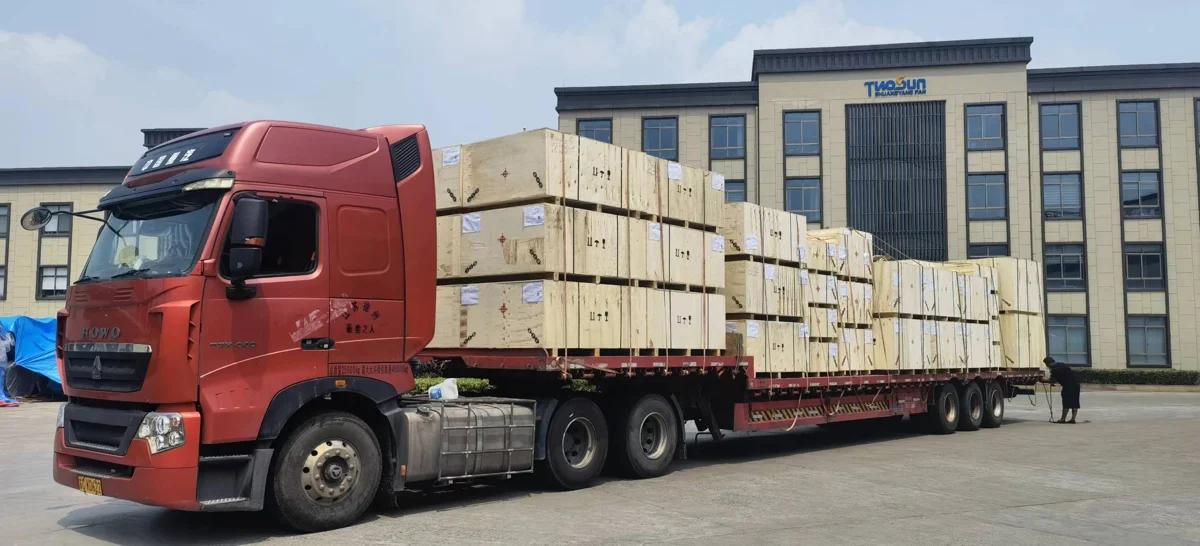
Export packing should be specified for the selected fan and destination
TWOSUN’s site shows equipment packed in wooden export cases and describes packing and delivery coordination. That is evidence of a packing route to discuss, not a specification for every shipment. Obtain the package dimensions, weights, support arrangement and preservation information for the actual selected assembly and separately supplied components.
A centrifugal fan and a long DTF assembly create different handling questions
For a 4-79 or 9-26 assembly, identify projecting connections and any separately supplied drive or accessory items. For a DTF(R) arrangement, review the complete packed envelope and handling route. The freight and receiving plan should use those actual details rather than a dimensional estimate made from a representative photograph.
A distributor consolidating GDF units and an HTFC cabinet in one shipment should retain separate equipment identities and packing references. The receiving team needs to match each assembly to its approved configuration. A single broad ventilation-equipment description may be inadequate for checking that all matched components and documents have arrived.
If matched components occupy different packages, ask the packing list to preserve their relationship to the fan equipment tag. A cabinet’s separately supplied item should not be mistaken for a loose accessory belonging to a GDF unit elsewhere in the shipment. Agree the receiving information before packing, while the factory and project teams can still reconcile the actual supplied scope against the approved schedule.
Wood-packaging requirements should be confirmed for the actual shipment
The IPPC implementation resources for ISPM 15 explain the international framework for regulated wood packaging. Determine the applicable current requirements for the packing material and destination with the relevant shipment professionals. TWOSUN’s packing photograph does not independently establish treatment, marking or acceptance of every future package.
Include any required packing evidence in the order arrangements before dispatch. Do not infer compliance from the word export in a quotation. The selected fan’s preservation and handling requirements should also remain available to the receiving team if installation will follow after a storage period.
Separate factory evidence, product approval and delivery responsibilities
TWOSUN describes fabrication, aerodynamic testing, balancing and inspection in its manufacturing and testing information. Agree the equipment-specific records required by the project. If a foreign specification calls for a particular approval, test or witnessing arrangement, state it explicitly and request confirmation of the proposed scope before production release.
A management-system document, laboratory accreditation and product approval answer different questions. TWOSUN also distinguishes AMCA association membership from Certified Ratings. Request current documents relevant to the selected fan and intended application rather than treating one company-level certificate as acceptance evidence for every item in the export package.
Commercial delivery terms should identify the responsibilities actually agreed between buyer and seller. ICC’s explanation of Incoterms rules describes their role in clarifying delivery tasks, costs and risks. A reference to a trade term should accompany a clear equipment and delivery scope; it does not replace the complete sale contract or settle every technical requirement.
Request a schedule against the real approval, manufacturing, inspection and dispatch milestones. A repeated GDF configuration and a DTF(R) order with additional project records may follow different review paths. TWOSUN’s public information does not establish one fixed lead time for every fan family, nor a guaranteed transit or customs-clearance duration.
For a project needing staged deliveries, identify the equipment groups and readiness dates rather than asking for a single broad completion date. A DTF(R) shaft assembly may depend on a different site access milestone from an HTFC-II cabinet. The manufacturer’s proposed dispatch plan and the contractor’s receiving plan should describe those named groups, including the documents that must be reviewed before each release.
The overseas order becomes practical when the approved fan, its documents and its shipment describe the same equipment. Keep the selected 4-79, 9-26, DTF(R), HTFC-II or GDF configuration identifiable across those stages. The distance between factory and site makes a clear decision record more valuable, because an unresolved interface becomes harder to correct after dispatch.
